
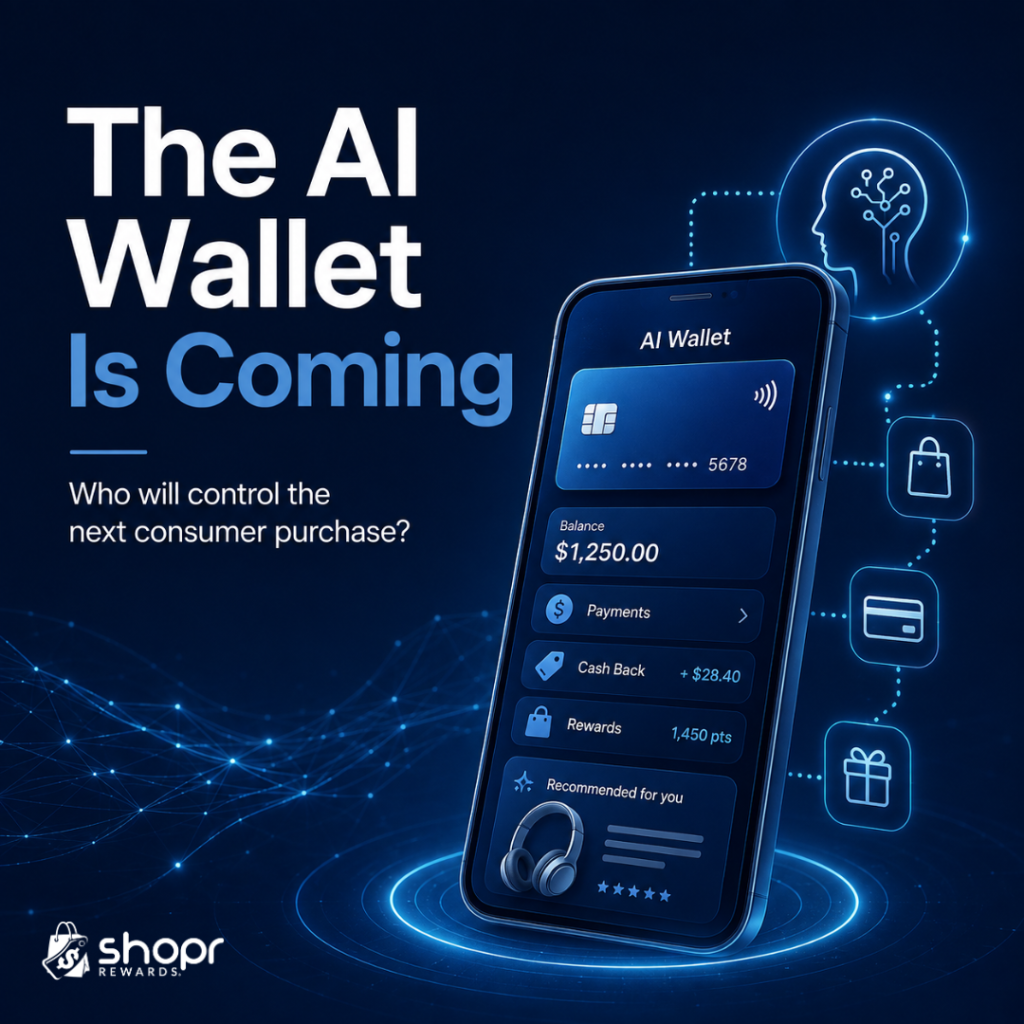
 For years, digital wallets have made it easier to store cards, access payment methods, and complete transactions with a tap.
The next evolution could do much more.
Imagine telling an AI assistant that you need a new pair of running shoes under $150. Instead of simply showing search results, it could compare products, account for your preferences, identify discounts, determine whether you have rewards available, select a payment method, and potentially complete the transaction.
That emerging model is often called agentic commerce: a form of shopping in which artificial intelligence can perform parts of the purchasing journey on a consumer’s behalf.
It could fundamentally change the question businesses ask about digital commerce.
Instead of simply asking, “How do we convince the customer to choose us?” retailers may eventually need to ask, “How do we make sure the customer’s AI chooses us?”
From Search Assistant to Shopping Agent
AI is already becoming part of product discovery.
Consumers can ask conversational tools to recommend laptops, compare hotels, find gifts, evaluate features, or narrow hundreds of options into a manageable shortlist. The next step is connecting those recommendations to the transaction itself.
That transition is already underway.
Google introduced its Universal Commerce Protocol in 2026 to help AI agents interact with merchants throughout the shopping journey, from discovery to purchasing and post-purchase support. Google has also outlined capabilities such as applying loyalty benefits within these experiences. Visa and Mastercard are separately developing infrastructure designed to let authorized AI agents transact securely on behalf of consumers.
In other words, AI may be moving from helping someone decide what to buy to helping execute the purchase.
The New Gatekeeper Could Be an Algorithm
Traditional digital marketing is largely designed to influence people.
Brands invest in promotions, reviews, personalized messaging, website design, and advertising intended to capture attention and persuade shoppers.
An AI agent may evaluate the decision differently.
If a consumer asks an agent to find the best option based on price, quality, delivery time, preferences, and available benefits, the technology can compare those factors almost instantly.
The winning brand may not be the one with the loudest advertisement. It may be the one offering the strongest combination of value, availability, relevance, trust, and accessible incentives.
Research highlighted by Harvard Business Review in 2026 suggests that many familiar online persuasion techniques may be less effective on AI shopping agents than they are on human shoppers.
That creates an entirely new competitive environment.
Rewards Could Become Part of the Decision Engine
Loyalty programs have traditionally depended on customers remembering they exist.
A shopper has to know they have points, notice an offer, open an app, enter a promotional code, or remember that one payment method provides a better benefit than another.
AI could reduce that friction considerably.
An agent could potentially recognize available rewards while evaluating a purchase and factor them into the decision automatically. Visa describes a future in which programmable payment rules could allow an agent to consider which account to use, whether rewards should be applied, and what other preferences should influence a transaction.
That changes the role of an incentive.
Instead of being something customers remember after deciding where to shop, a reward could become one of the factors determining where the purchase happens in the first place.
For loyalty and rewards providers, the shift reinforces a broader priority: making value simple to access, easy to understand, and increasingly compatible with the digital experiences consumers use to make purchasing decisions.
Consumers Are Not Handing Over Their Wallets Yet
There is an important distinction between what AI can do and what people are ready to let it do.
A 2026 Gartner survey found that consumers showed greater willingness to let AI narrow purchasing options than to allow it to make the final decision. In lower-stakes categories, willingness to let AI independently make purchase decisions reached only 11%.
That suggests the transition will likely happen in stages.
People may first rely on agents for research, comparison, deal discovery, and reward optimization while keeping final approval for themselves. Greater autonomy could follow as security, transparency, and confidence improve.
Trust will therefore be critical. Consumers will need to understand what an agent is authorized to purchase, which information it can access, and what happens when something goes wrong.
Mastercard and Visa are already developing systems focused on authorization, identity, permissions, and security for agent-led transactions.
Preparing for a Different Customer Journey
The rise of AI shopping agents does not mean brands will stop building relationships with people.
It means another layer may increasingly sit between consumer intent and the final transaction.
Retailers will need accurate product information that AI systems can interpret. Fintech platforms will need secure ways to connect identity, preferences, payments, and permissions. Loyalty providers will need benefits that can be discovered and activated within increasingly automated experiences.
Brands may also need to consider what makes them attractive not only to the person making a purchase, but to the technology helping that person decide.
The AI wallet is still emerging. Consumers remain firmly involved in purchasing decisions, and the infrastructure supporting autonomous commerce continues to develop.
But the direction is becoming clearer.
The next phase of customer loyalty may not begin at the checkout page.
It may begin one step earlier—with the technology helping consumers decide which options are worth considering at all.